Heiligenhafen, Baltic Sea
August 17 – September 4, 2026
oose by the Sea 2026
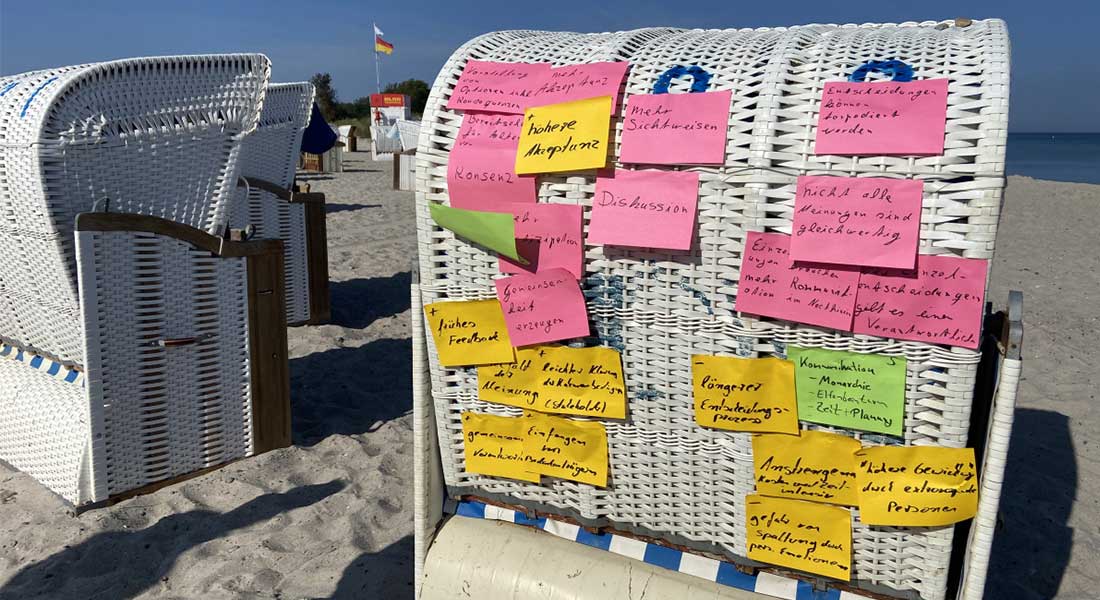
Learn, relax, grow together – oose by the Sea is more than just a seminar. It is a time-out for your mind and heart, with a sea view. In 2026, we celebrate our 10th anniversary in Heiligenhafen!
What awaits you
-
Impulse
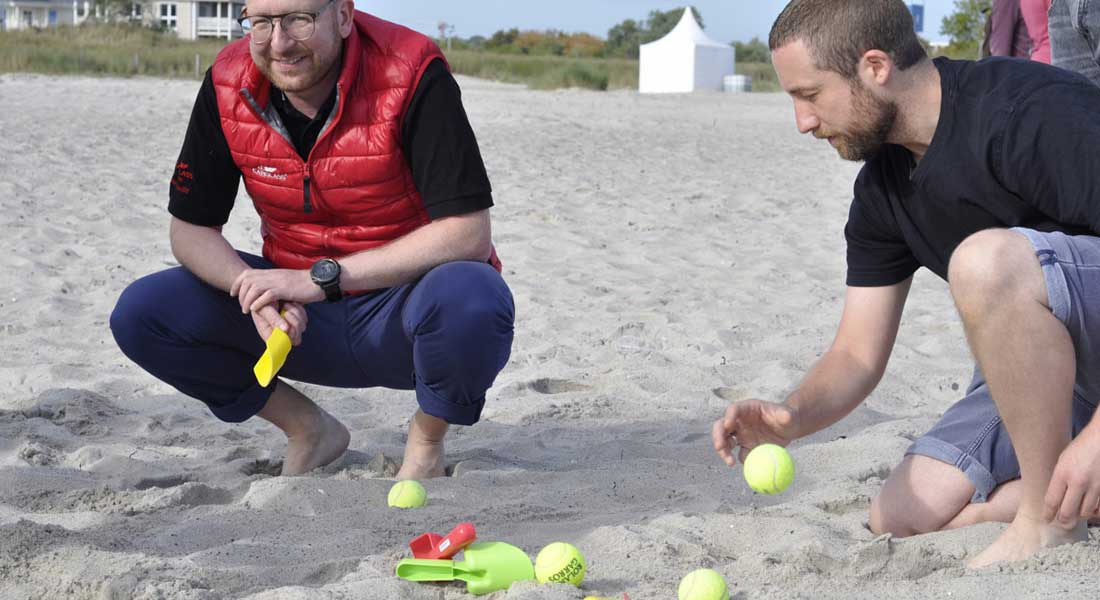
Every day begins like a normal seminar day. Except that some people jump into the sea first.
-
Learning
Deepen your knowledge in workshops and guided sessions. Immerse yourself in topics. Or in the sea.
-
Free space
Time for exchange, reflection – and a walk by the sea. Don´t forget your swimwear.
10 Years of oose by the Sea – we celebrate with a special retrospective.
Anniversary
How it all began, what we learned, and what remains: Our anniversary impulse looks back – and forward. Be curious!
Agenda
At oose by the Sea, we combine well-founded learning with a relaxed atmosphere: workshops, reflection rounds, and facilitated formats alternate. There is room for conversations, new perspectives – and the Baltic Sea breeze.
You can look forward to inspiring impulses and an open culture of learning.
-
Andrea Grass
Trainer, Consultant
-
Andrea Grass
Trainer, Consultant
- Fundamentals of communication theory with practical relevance in IT
- Successfully leading one-on-one and group conversations
- Feedback & constructive criticism
- Facilitation techniques & remote tools for distributed teams
- Hands-on practice of conversation situations in an IT context
- Dealing with difficult conversation and facilitation situations
-
Kristin Schwartz
Trainer, Consultant
- Fundamentals & documentation in RE
- Requirements development & RE processes
- Tools & techniques in RE
-
Sarah Schuh
Trainer, Consultant
- Identify and prioritize stress triggers
- Reflect on your own stress patterns and reactions
- Use breathing and focus techniques deliberately
- Integrate short relaxation exercises into everyday life
- Identify your own room for action
- Strengthen self-efficacy consciously
- Develop personal resilience sustainably
-
Dr. Pia Gebhardt
Trainer, Consultant
- Structure content for your target audience
- Develop a clear storyline & core message
- Use visuals & interaction deliberately
- Optimize presence, voice & body language
-
Sarah Schuh
Trainer, Consultant
- Conflict theory basics
- Building hypotheses about conflict situations
- Resolution strategies & win-win principles
- Understanding typical conflict situations in IT projects
- Self-care & self-reflection in conflict
-
Andrea Grass
Trainer, Consultant
- Fundamentals of conflict management
- Reflect on your own behavioral patterns
- Recognize & classify conflicts early
- Conflict analysis (types, stages, temperature)
- Constructive feedback & conflict conversations
-
Dr. Marcus Winteroll
Trainer, Consultant
- Apply AI across all RE phases
- Fundamentals of generative AI
- Best practices & real examples
- Test & evaluate AI tools
- Challenges and limitations
-
Andrea Grass
Trainer, Consultant
- Detect conflict signals in day-to-day PO work early and interpret them correctly
- Understand causes and dynamics of conflicts
- Reflect on your role, mindset, and patterns in conflict
- Communication strategies for difficult conversations
- Build trust and facilitate sustainable solutions
-
Sarah Schuh
Trainer, Consultant
- Differentiate conflict types and understand conflict dynamics
- Recognize and classify conflicts early
- Conduct conflict analysis and form hypotheses
- Derive suitable resolution strategies
- Lead constructive feedback and conflict conversations
Communication, Moderation and Fundamentals of Conflict Management
Spend 5 days focusing on constructive communication, confident facilitation, and effective conflict resolution.
What you will learn
Explanation models to identify communication misunderstandings Techniques for successfully leading one-on-one and group conversations Facilitation techniques and remote tools Expectations and responsibilities of the facilitator role Handling difficult conversation situations Introduction to conflict management Reflection on your own behavioral patterns when dealing with conflict Conflict analysis and how to learn and conduct a feedback/criticism conversation Gain the essential toolkit to facilitate groups purposefully in workshops, run meetings more effectively, and communicate more successfully with colleagues, subject-matter experts, or stakeholders.
More confidence in communication and facilitation
In the first part of this combined training, you will learn how to make conversation situations even more efficient and impactful with a solid repertoire of methods—regardless of the role you are in. You will also get to know new approaches and techniques that help you facilitate workshops, meetings, retrospectives, requirements workshops, sprint reviews, etc. with confidence and poise. You also have the option to receive immediate feedback on relevant communication dimensions (e.g., speaking speed, filler words, or tone) using a VR headset.
Apply conflict management effectively
In the second part, you will learn to recognize conflicts early and address them constructively. A structured conflict analysis with different dimensions will help you categorize conflicts better in the future. Conducting a constructive feedback/criticism conversation rounds off the second part of the seminar week.
Practice-oriented and with individual feedback
Using your own real-world examples from your professional environment, you will work through the topics interactively across all five workshop days in a trusting atmosphere. Regular feedback within the group as well as reflection will support you precisely and appropriately throughout the days. This way, you not only internalize the techniques, but also receive focused impulses for your personal development.
Choose your module or combine
Choose whether you want to book individual modules such as Communication & Facilitation (3 days) or Conflict Management & Constructive Conflict Resolution (2 days), or experience them as a combined five-day seminar like in this training. Each module is designed to teach you specific skills that fundamentally improve your daily work and interactions.
You take this knowledge with you ...
In addition to the seminar materials, each participant also receives the e-book “Soft Skills for Software Developers” by Uwe Vigenschow, Björn Schneider and Ines Meyrose.
Prerequisites
Professional experience
Communication & Moderation Techniques in IT – with lots of remote tools
Learn essential skills to communicate effectively in IT and facilitate meetings in a lively way.
What you will learn
Make meetings effective
Learn to shape conversation situations efficiently, effectively, and with energy—whether in a sprint review or a customer workshop. With the help of a VR headset you will receive direct feedback on tone, speaking speed, and much more.
Master remote facilitation
You will learn tools and techniques to facilitate online with confidence—interactive and collaborative.
Practice & transfer
Through exercises using your own case examples and structured feedback, you will further develop your individual facilitation style—for more impact in your day-to-day work.
You take this knowledge with you …
In addition to the seminar, you will receive the e-book “Soft Skills for Software Developers”.
Prerequisites
No special prior knowledge required.
IREB Certified Professional for Requirements Engineering – Foundation Level
Level up in Requirements Engineering – and secure your IREB certification with sustainable learning transfer.
What you will learn
Interactive & exam-focused
With case studies and hands-on exercises, you will deepen your knowledge—and be optimally prepared for the CPRE exam.
Exchange & network
Benefit from the trainers’ expertise and the exchange with like-minded participants.
AI added value
Book “Requirements Engineering with AI” right afterwards to expand your knowledge.
SkillsClub
After passing the exam, you become part of the largest network of certified RE professionals.
Prerequisites
No specific prior knowledge required—just curiosity and joy of learning.
From Stress to Strength: Learn Resilience in Practice
Stay calm in your daily work: Notice stressors, recognize room for action, and use it consciously.
What you will learn
Practical instead of theoretical
All methods are tried out directly: with exercises, reflection, and exchange in the group. This helps you anchor what you learn and apply it right away.
Tools for your everyday life
You will take concrete techniques, small routines, and personal strategies with you to stay calm, clear, and capable of acting even in challenging situations.
Prerequisites
None.
Presenting Professionally
Present clearly, convincingly, and authentically—whether in a meeting, in front of customers, or on stage.
What you will learn
From idea to performance
Create presentations with structure and impact—and learn how to actively involve your audience.
Practical & with VR
Thanks to VR simulations, you receive direct feedback on your presence, body language, and impact—in a safe space.
Conflict Management for Developers
How do you deal with tension in everyday project work? This seminar gives you the right toolkit.
What you will learn
Developed with developers
Using realistic case studies from software projects, you will learn to recognize, classify, and resolve tensions—for the benefit of both the project and the people.
Between tech & humanity
You will develop strategies to handle interpersonal complexity with the same clarity you bring to technical challenges.
Practice & reflect
In exercises and reflection rounds, you strengthen your conflict behavior and how you handle difficult situations—for more confidence.
Conflict Management and Constructive Conflict Resolution
Learn to analyze conflicts effectively and resolve them constructively—for more clarity and impact in your daily work.
What you will learn
Tools & techniques
You will receive effective methods to not only de-escalate conflicts, but also turn them into opportunities for your team.
Practice-oriented
Using your own examples, you will experience the process from analysis to resolution in a hands-on way—with targeted feedback in a protected setting.
You take this knowledge with you …
E-book “Soft Skills for Software Developers” included.
Prerequisites
Participation in “Communication & Moderation” or comparable prior knowledge.
Requirements Engineering with AI
Discover how AI supports you in Requirements Engineering—from use cases to tool integration.
What you will learn
AI as an assistant
Recognize potential and learn how to integrate AI-supported tools effectively into your RE process.
Practical & interactive
With exercises, case studies, and discussions—bring your own laptop and get started right away!
Prerequisites
CPRE-FL seminar or comparable RE experience. Access to a chatbot (e.g., ChatGPT) required.
Constructive Conflict Resolution: A Seminar for Product Owners
As a Product Owner, you juggle expectations, priorities, and interests every day—conflicts are often inevitable. In this seminar you learn to recognize them early, clarify them safely, and use them as a chance for better collaboration.
What you will learn
Recognizing conflicts
You will work with tools that help you notice conflicts early, classify them, and act proactively—before situations escalate unnecessarily.
Self-reflection and communication strategies
You will gain insights into effective strategies to stay clear even in heated discussions. In role plays and simulations, you will practice typical conflict situations from your context.
Your path to successful conflict resolution
By the end of the seminar, you will be able to not only resolve conflicts, but also use them deliberately to improve collaboration and product development—and secure support from both team and stakeholders.
Prerequisites
Experience as a Product Owner or in a comparable interface role is helpful, but not required.
Conflict Management and Constructive Conflict Resolution
Software projects come with constraints—budget, timelines, dependencies, and differing interests. Conflicts arise from that. In this seminar, you learn to recognize conflicts early and use existing conflict potential constructively—for less friction, better collaboration, and better results.
What you will learn
Tools for dealing with conflict
You will learn effective techniques that help you in everyday work to address conflicts structurally instead of “pushing them away”.
Practical examples and techniques
You will work with your own real cases and experience the path from analysis to resolution in a protected, trusting atmosphere. Feedback and reflection help you anchor the techniques reliably.
Transfer to your everyday work
You will leave with a clear approach, practical conversation guides, and greater confidence to act.
Prerequisites
No special prior knowledge required.
-
Sebastian Hirschmeier
Trainer, Consultant
-
Stephan Roth
Trainer, Consultant
- Development process & design
- Role of the architect & quality attributes
- Make & evaluate architecture decisions
- Documentation & tools
-
Tina Busch
Trainer, Consultant
- Communication basics & conducting conversations
- Visualizing & facilitating
- Handling objections and criticism
- Conflict analysis & options for action
-
Georg Haupt
Trainer, Consultant
- Testing fundamentals & test strategies
- Life cycle & static testing
- Test analysis, design & management
- Tools and methods
-
Maren Wischer
Trainer, Consultant
- Core concepts and principles of Systems Engineering
- Systems thinking: define boundaries, understand context, integrate perspectives
- Structured approaches to developing complex systems
- Typical methods and approaches to master complexity
- Transfer of insights to your own work context
Lively Software Architecture with Method incl. iSAQB-CPSA-F Certification
Understand, design, and document architecture—with method and practical relevance.
What you will learn
Hands-on with a case study
Experience how architecture is created systematically—from system context to patterns, decisions, and communicating them.
Tools & techniques
Work with established tools such as quality scenarios and metrics to plan and assess architectures.
Communication in focus
Learn to explain your architecture clearly, gather feedback, and document decisions in a traceable way.
You take this knowledge with you …
E-book “Effective Software Architectures” included.
SkillsClub & certification
After passing the exam, you become part of the SkillsClub. The exam takes place directly afterwards (on-site).
Prerequisites
Experience with object-oriented programming; basic UML knowledge is helpful.
Soft Skills for Architects (SOFT)
Communication is a key competence—especially for architects.
What you will learn
Practical & personal
Experience interactive exercises, develop your style further, and learn to assert yourself confidently in difficult situations.
iSAQB Advanced Module (CPSA-A)
This licensed module covers the topic “Communicative Competence” — 30 credit points included.
You take this knowledge with you …
Includes the e-book “Soft Skills for Software Developers”—also relevant for architects.
Prerequisites
No special prior knowledge required.
ISTQB® Certified Tester Foundation Level (incl. certification) (CTFL)
Testing is more than finding bugs—it is ensuring quality.
What you will learn
Fundamentals & practice combined
Based on current standards, you learn systematically how professional software testing works—with exercises and direct transfer.
Ready for the exam
Our experienced trainers prepare you specifically for the CTFL certification—includes the e-book “Software Testing according to ISTQB for Dummies”.
SkillsClub & exchange
After the exam you become part of a global network of certified professionals.
Prerequisites
Basic knowledge in software development or testing is helpful—but not required.
Systems Engineering Fundamentals
Are you interested in Systems Engineering? In this seminar you will get a practical introduction to how to develop and manage complex systems successfully—based on the INCOSE Systems Engineering Handbook and the ISO/IEC/IEEE 15288 standard.
What you will learn
Understanding Systems Engineering methods
Today’s systems development is shaped by connectivity, regulation, and organizational complexity. You will learn why a structured approach matters—and how Systems Engineering supports it.
Practical project: apply systems thinking
You will work on an illustrative example project and experience how systems thinking is used in practice—from placing the system in context to selecting suitable methods.
Transfer and next steps
You will take a stable foundation with you to apply Systems Engineering in daily work—as a shared language and a pragmatic toolbox.
Prerequisites
None.
-
Marco Thede
Trainer, Consultant
-
Tina Busch
Trainer, Consultant
-
Sebastian Hirschmeier
Trainer, Consultant
- Identify architectural requirements in an agile way
- Integrate architecture work into a Scrum process
- Decide consciously what is needed “now” and what can be postponed
- Evaluate architecture collaboratively in the team and make decisions traceable
- Learn through active participation, reflection, and practical application
-
Axel Scheithauer
Trainer, Consultant
-
Tina Busch
Trainer, Consultant
-
Sebastian Hirschmeier
Trainer, Consultant
Software Architecture for Developers
Architecture is not an end in itself—it emerges from the interplay of development, decisions, and implementation.
What you will learn
Difference between design and architecture Purpose and benefits of explicit architecture Agile architecture and iterative approaches Working with scenarios Handling the tension between "features vs. architecture" Modularization, dependencies, and cross-cutting concerns Working with patterns, principles, and concepts Quality in architecture and implementation Interplay of architecture, code, and tests Role of developers in architecture decisions Recognizing and communicating risks
Responsibility and influence of developers
This seminar shows the central role developers play in the creation and quality of software architecture. You learn how architecture is influenced through implementation—and how to take this responsibility consciously.
Architecture in everyday development
With practical examples, you will see how architecture emerges iteratively and incrementally. Lightweight tools and role models help you shape architecture effectively and pragmatically.
Case studies & exercises
In role plays and exercises, you experience what it means to design architecture explicitly—and how clear structures affect development work and quality.
Prerequisites
Programming skills and experience from software projects.
Leading Agility
Agile leadership means sharing responsibility, providing orientation, and shaping collaboration intentionally.
What you will learn
Models and principles of agile leadership Leading at eye level—opportunities and challenges Reflection on your own mindset, values, and principles Dealing with new demands in an agile environment Participative methods such as constructive feedback, team building, and decision-making processes Dealing with groups, dynamics, and psychosocial processes
Leadership in the modern working world
In agile organizations, roles, expectations, and structures are changing. This seminar shows you how to lead consciously—cooperatively, participatively, and effectively.
Values & techniques
You will work intensively on your own values and learn concrete tools to apply agile leadership in everyday life.
Exchange & reflection
In a trusting atmosphere, you reflect on your leadership role, receive feedback, and benefit from exchange with other leaders.
Prerequisites
Basic knowledge in communication and facilitation is helpful.
Agile Software Architectures
In agile contexts, the question keeps coming up: How much architecture is needed now—and what can wait? In this seminar, you combine agile ways of working and architecture work using a continuous case study including a simulation.
What you will learn
Case study with simulation
You will work throughout on an example that makes typical practical tensions visible—and use it to try out approaches and decisions.
Collaborative evaluation of software architecture
You learn how to evaluate architecture together as a team to reach well-founded decisions—with practices that strengthen arguments instead of just counting majorities.
Learning by doing
Less lecture, more practice: Through active participation and reflection, you anchor the content so you can apply it directly in your day-to-day work.
Prerequisites
Practical experience in designing and developing systems as well as an agile context in your environment are advantageous.
Model-Based Systems Engineering with SysML v2
SysML v2 is the next generation of system modeling—powerful, modern, and practice-oriented.
What you will learn
Introduction to Systems Engineering Fundamentals and architecture of SysML v2 System context and use case analysis Modeling requirements, structure, and behavior Model organization and methodology (SYSMOD)
From UML to SysML v2
You will understand the limits of SysML v1 and learn why SysML v2 better meets the needs of modern system development.
Practice-oriented application
Using real examples, you will work with SysML v2 from idea to architecture and connect theory directly with practice.
Learn from the developers
oose is part of the SysML v2 development team—you receive exclusive first-hand knowledge.
You take this knowledge with you …
Book “Don’t Panic! – The Absolute Beginners Guide to SysML v2” included.
Prerequisites
UML/SysML knowledge is helpful, but not required.
Make Software Architecture Decisions at Eye Level
Good architecture decisions are made together—not in isolation.
What you will learn
Difference between architecture and other technical decisions Clarifying roles in architecture decisions Mindset and attitude for collaborative decision-making Methods of participative decision-making Systemic consensus-building Facilitating decision-making processes Documenting architecture decisions
Benefits of collaborative decision-making
You will learn how shared decision processes not only deliver better results, but also strengthen responsibility, acceptance, and team cohesion.
Practical application
Using your own questions, you apply methods directly, reflect on outcomes, and gain confidence for real decision situations.
Benefit for your team
With the techniques you learn, you improve decision-making ability, reduce conflicts, and handle complex technical challenges with confidence.
Prerequisites
Basics in software architecture are helpful, but not required.
Why oose by the Sea?
-
Inspiration
Impulses from experienced practitioners – compact, suitable for everyday use.
-
Time out
Time for yourself – get ahead professionally, recharge your batteries personally.
-
Community
Learning in an open, appreciative group.
Reviews
Frequently asked questions
-
The seminar price includes participation in the seminar, any applicable exam fees, and meals during the seminar (lunch, snacks during breaks, and beverages). Hotel and travel expenses are not included in the seminar price.
-
The Beach Motel is located at Seebrückenpromenade 3, and the Bretterbude is located at Seebrückenpromenade 4. Both have their own parking spaces. In addition, there is the “Steinwarder parking lot” nearby.
-
oose am Meer offers a combination of high-quality content, time for reflection and exchange in a special location that leaves a lasting impression. Between learning units, there is deliberately time for reflection, conversation or a walk by the sea. The day is clearly structured – but not tightly scheduled. The atmosphere is light-hearted, open, and appreciative. People meet on equal terms – without pressure to perform or put on a show.
-
The seminars at oose am Meer are strongly practice-oriented. You work with real examples from your professional context, receive feedback, and apply methods directly. Theory provides structure, not rigidity.
-
Yes – that is a core idea of oose am Meer. Many participants extend their stay or travel with a partner or family. Learning and recovery can be combined seamlessly.
-
Yes. Many participants combine multiple modules or seminar weeks. The program is designed so that combinations are possible in terms of content and timing.
-
This depends on the specific seminar. Some trainings are suitable for beginners, while others target experienced professionals. Prerequisites are clearly stated in each program description.
-
Yes. Heiligenhafen offers a broad range of hotels, holiday apartments, and guesthouses across different price levels. After booking, you will receive recommendations that have worked well for previous participants.
-
Booking is done online directly via oose. You select your seminar, complete the booking, and receive all organizational details by email.
-
Because it is always so beautiful and inspiring, oose am Meer 2026 will once again take place on the sun deck of the Baltic Sea: in Heiligenhafen – about 120 kilometers from Hamburg. And this year, we can once again highly recommend the stylish Bretterbude and the Beach Motel. Both offer the perfect setting for our training sessions on the beach.
A quick note: hotels in Heiligenhafen book up quickly during the summer months, so it's worth reserving early! If you are traveling by train, you should know that rail replacement services will be in operation from Lübeck for the next few years due to the Fehmarn Belt Fixed Link. You can take the X85 bus to Oldenburg station. From there, you can easily take the bus or a taxi to Heiligenhafen, which is about 12 km away. We look forward to seeing you!
-
Groups are intentionally kept small. This allows for focused work, meaningful exchange, and individual feedback instead of a mass-event experience.
-
Yes. Exchange is a central part of the experience. Whether during meals, walks by the sea, or spontaneous conversations, learning continues beyond the seminar room.
-
Training days usually start with a short practical impulse, followed by focused learning and workshop phases. Between sessions, there is intentionally time for exchange, reflection, or a walk by the sea. The day is structured, but not exhausting.
-
The standard oose cancellation terms apply and are shown transparently before booking. If you have questions or special circumstances, the organizing team will assist you directly.
-
oose am Meer is a multi-week learning experience by the Baltic Sea. You take part in clearly structured trainings and workshops, complemented by space for exchange, reflection, and recovery. It is not a classic conference format, but a deliberately deep learning experience with time to let insights settle.
-
The atmosphere is calm, open, and respectful. People meet as peers, without pressure or performance. Learning here is meant to be both deep and restorative.
-
oose am Meer takes place in Heiligenhafen on the Baltic Sea. The learning locations are close to the water, with short distances between seminar rooms, the beach, and accommodation.
-
oose am Meer is designed for people working in IT, software development, product, architecture, testing, leadership, and organizational roles. Anyone who wants to learn with depth and reflection is welcome.
-
Because the combination of high-quality learning, time to think, and a special location creates lasting impact. Many return to continue learning and because they value the people, mindset, and setting.

Organizers
As a Hamburg training company, we have been offering seminars, workshops, and coaching sessions throughout the German-speaking region for over 20 years. Since 2014, we have been a cooperative, working self-organized and without bosses.
- 20+ years of experience as an education provider
- 120+ different seminars
- 5,500+ customers
- 20,000+ participants